A leadership journey - and a dual transformation
What does it really take to succeed with digital transformation in a municipality? For the City of Nacka, it was not about implementing more systems. It was about leadership clarity, organisational anchoring — and structure.
When Nacka was named a finalist in Sweden’s Digital Municipality of the Year 2025, it marked the result of several years of systematic work to align development efforts across the organisation — and to tightly connect digitalisation with sustainable societal transformation.
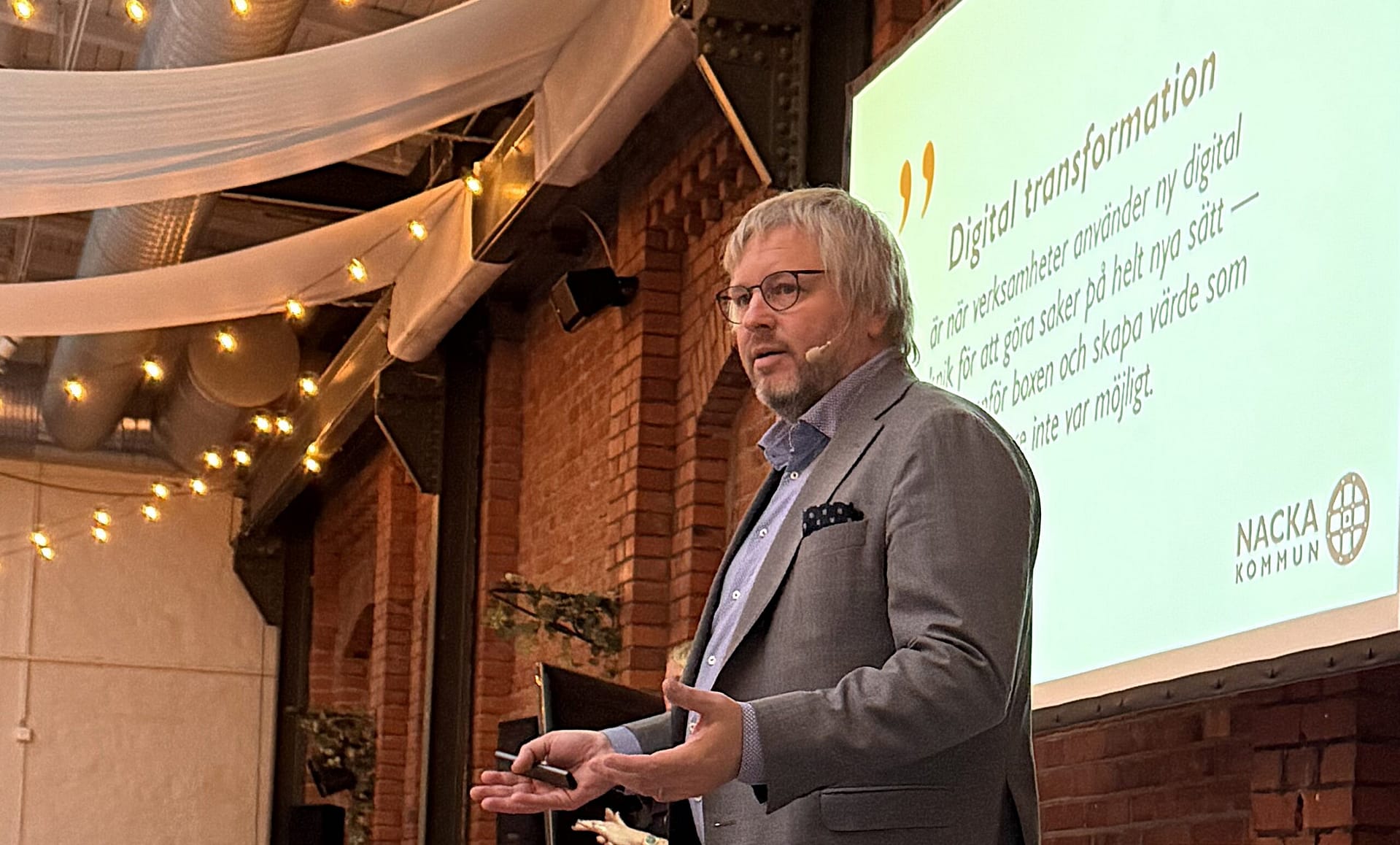
– Digitalisation is not about technology. It’s about people, says Henrik Palmblad Wennergren, Chief Digital Officer of Nacka.
From isolated initiatives to strategic direction
When Henrik stepped into his role four years ago, the challenge was not a lack of ambition.
– There was strong development energy throughout the organisation. The real challenge was getting us to do smart things together.
Many municipalities have strong professional environments and promising individual projects. But without overarching structure, development risks happening in parallel rather than collectively.
Nacka therefore established clear strategic tracks:
- Smart City Nacka
- A Data-Driven Municipality
- AI Transformation
- Sustainable Transition
– If you can place a strategic layer over everything happening in the municipality, you create frameworks that make the work coherent and clear.
Digitalisation and sustainability — two sides of the same transformation
In Nacka, digitalisation and sustainability are not treated as separate agendas. They are seen as interdependent. Digital development is used to:
- Enable more precise resource allocation
- Improve decision-making through better data
- Streamline workflows
- Reduce unnecessary administrative burden
At the same time, sustainability provides direction for digitalisation.
– When we connect our digital efforts to demographic shifts, financial constraints and climate ambitions, it becomes clear why we are doing this.
The dual transformation — digital and green — is therefore not two parallel processes, but one integrated strategic direction.
The alignment between digitalisation and sustainability is anchored at leadership level. Municipality Director Victor Kilén underlines this perspective:
– In Nacka, digitalisation and sustainable transition are not separate initiatives — they are a shared leadership priority. By working systematically and long-term, we strengthen both service quality and our responsibility for public resources.

Anchoring before acceleration
Transformation of this kind cannot be organised as a side initiative.
– It must become part of everyday operations.
Nacka has therefore worked systematically with:
- Cross-functional involvement
- Shared language and understanding
- Alignment between strategy and operational delivery
- Coherence between development initiatives and budget priorities
The municipality measures its digital maturity using the DIMIOS model developed by the University of Gothenburg, and has seen clear progress over time. The result is increased organisational capacity — and a stronger ability to manage both economic and societal change.


External support — clear ownership
Innovation often challenges established structures. Nacka therefore chose to involve external expertise to help design frameworks and methodologies.
– We can develop the frameworks together with external partners. But we have to own the implementation.
In collaboration with BJØRK Innovation and with support from knowledge institutions such as KTH and RISE, Nacka has developed a model for holistic smart city development, integrating urban planning, data, sustainability and organisational development.
The balance has been crucial:
- External structure and methodology
- Internal ownership and responsibility
It is this combination that has elevated the work from isolated pilot projects to lasting organisational capability — ensuring that digitalisation and sustainability move in the same direction.
Anchored in real societal challenges
The work is not driven by technological enthusiasm, but by concrete societal realities:
- Demographic change
- Rising expectations for accessibility and responsiveness
- Increasing financial pressure
– When we connect digital transformation to these challenges, it becomes clear why we are doing what we are doing.
Transformation gains real momentum only when it is anchored in the public mission — and when direction, structure and ownership are aligned.
Three lessons from Nacka
Henrik summarises the journey:
- Start with anchoring — everyone must understand why.
- Involve the organisation — transformation must become part of daily work.
- Be clear about purpose — delivering high quality for citizens, today and tomorrow.
Nacka’s experience shows that transformation is not created through speed alone. It emerges when digital development and sustainable transition are integrated into one coherent leadership direction — supported by clear structure and long-term ownership.
Read more about the initiatives in Nacka: